CCW 2025 Presents: “Echoes of Time · Kindred in a Foreign Land”
Edinburgh, August 2025 – The Intercultural Connections Initiative (ICI) is proud to present “Kindred in a Foreign Land” as part of Chinese Culture Week 2025 (CCW 2025), under the umbrella exhibition “Echoes of Time”. This exhibition invites audiences to traverse the intersections of history and contemporary artistic practice, where ancient Chinese traditions converse with contemporary expressions to form a poetic, immersive experience.
Curators Jiayi Chen (陈嘉奕) and Ying Yang (杨颖) have assembled a dynamic international roster of artists whose works echo memory, heritage, and cross-cultural resonance. Through painting, sculpture, photography, installation, and interdisciplinary media, these artists bring forth narratives that honor ancestral wisdom while interrogating contemporary identities and social experiences.
"At the heart of this exhibition is a simple truth: the past has never truly left us," says curator Jiayi Chen. "It continues to murmur and reverberate within every act of creation. These works honor the weight and beauty of cultural heritage while illuminating voices once hidden, allowing them to be seen and heard again."
Participating Artists
Oscar Mateos
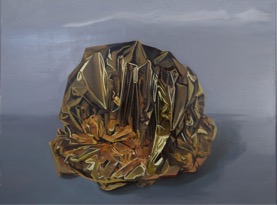
Art Title: Night (After Ferdinand Hodler)
Oil on canvas, 60 x 80 cm
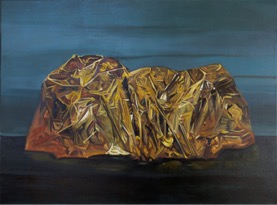
Art Title: Isle of the Dead (After Arnold Böcklin)
Oil on canvas, 60 x 80 cm
A series of paintings that weave together various visual and conceptual elements. Image and technique are interlaced with meaning and message, forming a kind of riddle for the viewer. Night by Ferdinand Hodler and Isle of the Dead by Arnold Böcklin served as sources of inspiration to construct a form using the material of thermal blankets—the same ones used to cover bodies, either to protect them or, as in this case, to shroud the corpses of migrants who perish trying to reach our shores in search of a better life.
The gold surface, which is not real gold, mirrors our society: a surface that, instead of offering protection and care, conceals our crimes. These are symbolist paintings about fear and death, about ancestral and archetypal anxieties that ultimately boil down to fear of the unknown—just like the fear of those who migrate. Xenophobia and racism, it seems, refuse to disappear from our society.
Gold, death, symbolism, and falsehood—these are the ideas that drift through the meaning of these works.
Artist Biography
Born and raised in Seville, I’ve been a painter and draughtsman since childhood. My passion for art has always gone hand-in-hand with a deep disillusionment toward the art world itself. As a working-class artist, I’ve explored art through its less privileged channels—those less visible in the collective imagination. I’ve painted in the streets and for the streets, painted on commission and without desire.
After a long break that began in 2003 and lasted until the birth of my first daughter in 2013, I decided to return to both art and academia. In 2021, I graduated with a degree in Painting from the University of Edinburgh, and later, in 2023, I completed a Master’s in Contemporary Art Practice at the same institution. Since returning to the art world over the past decade, I’ve had the chance to exhibit in several group shows, share the Astaire Prize 2021 with fellow artists, and receive a special mention in the FEUVA Prize 2021.
Luyin Cao
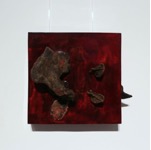
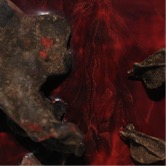
Title: Fresh Specimens of Witches
Year: 2024
Medium: Gauze, Bone, Pearl, Carbon Powder, Aluminium Powder, Lacquer
Dimensions: 20 × 20 × 15 cm and 23 × 23 × 15 cm
Luyin Cao is a Chinese artist based between China and London. A graduate of the China Academy of Art and the Slade School of Fine Art,
her practice centers on natural materials and handcrafts, working with wood carving, ceramics, lacquer, and fibers. She explores themes of
nature, feminism, and labor, reflecting on the historical and contemporary roles of women and their often-invisible contributions.
Kat Stanley
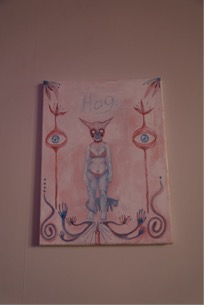
From Belfast, artist Kat Stanley creates a world steeped in folk belief and symbolism through painting, performance, and film. Her practice centers on female rage, treating it as an inherited force that transforms pain and suppression into language of catharsis and renewal. Her work invokes the power of the “monstrous femme” in Celtic traditions while prompting audiences to reflect on memory, scars, and transformation.
Lily hicks
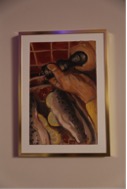
Cooking the trout,
Oil on canvas paper
2025
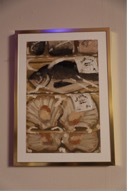
Morrison’s Seafood Selection,
Oil on canvas paper
2025
Lily Hicks is a 27-year-old American artist based in Leith, Edinburgh. Working primarily in oil paints and photography, Hicks seeks to engage viewers in conversations about nature and animals in restoring our views on identity, mental health and ways of living.
@LilyHicksArt on Instagram
April Stewart
Exhibited Works
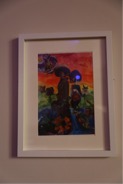
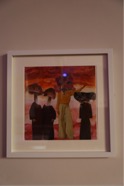
ISLAND OF LESBOS : I
(smaller work)
ISLAND OF LESBOS : II
(larger square work)
Artist Bio
April Stewart is an artist currently exploring themes of womanhood, neurodivergence, and queerness through her upcoming project ISLAND OF LESBOS. The work marks a process of coming to terms with herself, flowing into the natural landscapes and organisms that she engages with in her practice.
Bronwen Winter Phoenix
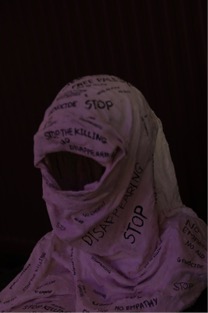
Artwork:Disappearing
Bronwen Winter Phoenix is an Edinburgh-based contemporary artist working in a wide range of traditional and digital mediums. Her practice explores the human condition and the curious world we find ourselves in – sometimes with a touch of whimsy. She often uses recycled materials to help encourage introspection whilst highlighting the importance of human connection and shared experience.
Debbie Miller
Body and Mind Estranged
This work is a meditation on the mind/ spirits increasing separation from the body in contemporary Western culture. The chair is a symbol for the human body and denotes its absence. The active and broken stitched spherical “mind/ spirit” are hanging on to the body by a thread (literally and metaphorically).
We increasingly live in our heads and thoughts which is exacerbated by social media and the virtual world. The body yearns to be reunified but is generally only thought of as a “meat machine” that needs to be exercised occasionally.
Descartes described bodies as incapable of feeling or thought; minds,in contrast, are thinking and feeling. This dualistic philosophy has infected Western culture since the Greeks and is embedded. Contemporary philosophers like Gabor Mate are challenging this viewpoint ( “ Even to speak about links between mind and body is to imply that two discrete entities are somehow connected to each other. Yet in life there is no such separation; there is no body that is not mind, no mind that is not body.”) as a tool to improve our mental, emotionaland physical health but most of the population are unaware and so the estrangement continues and widens.
This work reflects the theme in that our bodies are becoming a foreign land that our mind/ spirit yearns for.
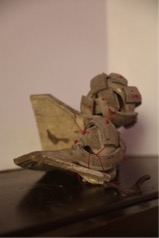
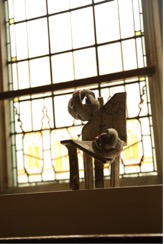
Deborah Miller is a Scottish artist and lecturer based in Midlothian. She graduated with a BA (Hons) in Fine Art (Sculpture) from Gray’s School of Art, Aberdeen in 1988 and later completed a Postgraduate Certificate in Secondary Education (Art and Design) at Moray House, Edinburgh.
Her sculptural and installation-based practice reflects on the relationship between body, mind, and spirit, often drawing on philosophy and contemporary culture. She has exhibited widely since the late 1980s, including a solo exhibition at the Collective Gallery, Edinburgh, and group shows such as New Contemporaries, Compass Gallery, the Royal Scottish Academy Student Exhibition, and the Society of Scottish Artists at the RSA.
Alongside her practice, Miller has worked extensively in art education. She has been a lecturer in Art and Design at Telford College/Edinburgh College since 1996 and has led workshops for both adults and children across Edinburgh, including at the Edinburgh Sculpture Workshop, where she was also a studio holder and education committee member.黛
Liwei teng
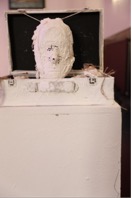
Title: Fragments
Artist: Liwei Teng
Materials: Found suitcase, plaster, jute scrim, white paint, casting
Size: Approx. 60cm x 50cm x 50cm
“Fragments” reflects on identity, migration, and memory. A weathered suitcase bursts with cast forms; torn, tangled, and suspended mid-motion. Made from jute scrim and plaster, these ghostly remnants evoke emotional turmoil and wounds, echoes of female identity and inner rupture. Twenty-eight years ago, as a young girl leaving Beijing to study in the UK, Liwei experienced the disorientation of being caught between worlds. This suitcase holds more than objects, it contains longing, loss, hope, and resilience. Each fragment tells a story of survival, of trying to hold onto pieces of self in unfamiliar terrain.
Liwei Teng is an interdisciplinary artist based in Edinburgh. Her practice and research explore the intersections of contemporary art, philosophy, and social issues. Working across 2D, 3D, and 4D media, her current projects are grounded in a multidisciplinary approach. She is an enthusiastic advocate for mother artists, parent-carers, and underrepresented voices. Liwei is a member of both the Society of Scottish Artists (SSA) and Visual Arts Scotland (VAS), and has exhibited widely, including in the annual exhibitions of both organisations. She holds a Master of Finance from the University of Glasgow and previously worked in investment and trade policy. She was a prize-winning watercolourist before transitioning to a career in contemporary art. She is currently pursuing her second postgraduate degree: an MA in Contemporary Art Practice at Edinburgh College of Art, University of Edinburgh.
Jingtang Wang
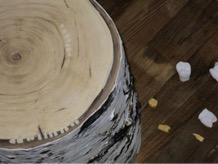
Jingtang Wang is an emerging interdisciplinary artist based in Beijing, currently pursuing a dual concentration in Fine Arts and Biological/Environmental Sciences. Her practice explores the evolving relationship between humans and nature, focusing on ecological transformation and the boundaries of self and environment through sculptural and conceptual works.
Xiaoping Yu
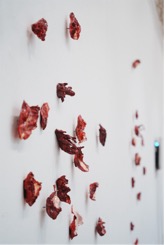
Title: Under My Skin
Medium: Clay, resin, Alginate
Dimensions: Various sizes, adjustable to wall
Year: 2024
Under My Skin is a wall sculpture that reflects the physical and emotional impact of the cultural shock I experienced as an international student in Edinburgh.
Shortly after arriving in the UK, I frequently became ill and took various medications, which eventually triggered Henoch-Schönlein purpura—an allergic reaction that caused red rashes and abdominal pain. This condition became a metaphor for how my body and mind struggled to adapt to a new environment. The skin, as our first line of defence, became a site where invisible psychological stress turned visible.
Using clay, I created distorted, virus-like forms that gradually merge with skin textures, representing the spread of illness and internal breakdown. The eerie materiality of the work was inspired by Pedro González’s Emorgi at the Emoji Orgy, whose unsettling faces evoke a sense of fear and discomfort, feelings I deeply resonated with during my illness.
Cultural shock is not just psychological. Changes in water, air, food, and environment can directly affect the body. Many international students suffer from rashes, allergies, or chronic fatigue, while also facing academic pressure and limited access to healthcare. These combined factors can lead to anxiety, insomnia, and emotional isolation.
Through this work, I want to highlight the often-ignored physical and mental challenges of cultural transition. More importantly, I hope it brings attention to the need for more compassionate support systems for international students navigating unfamiliar worlds.
Artist Bio: Xiaoping Yu is a Chinese artist based in Edinburgh. She has completed her Master's degree in Contemporary Art Practice at The University of Edinburgh. She believes that art knows no boundaries, so she is experimenting with various media. She makes sculpture, wall pieces, and installations in clay and resin. Her art concretizes the involuntary memories and emotions of the individual, revealing complexities that reflect existence, nature, history, and behaviour. One by one, the brushstrokes are scattered throughout the picture, encapsulating time and memories triggered by emotions and senses. Focusing on intricate details, her work aims to make the invisible visible, exploring the deep connections between herself and the world.
Xin Wei
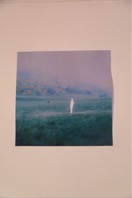
Ethereal Separation
This photograph explores the concept of dissociation, capturing the feeling of being physically present yet mentally detached from oneself. I chose to shoot in a foggy environment at Arthur’s Seat, a vast, wild landscape, where the mist blurs the boundaries between self and surroundings. By using a self-portrait in this setting, I aimed to recreate the psychological state of dissociation from a third-person perspective, observing myself as an almost ethereal figure in the distance. The figure, fading into the fog, represents a sense of isolation and detachment, as though the self is both here and not here at once. The fog and muted colors amplify the feeling of being lost in one’s own mind, disconnected from reality but still part of it
Elena Mendoza
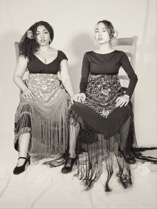
Elena Mendoza is an editorial and fine art photographer based in Scotland, working internationally. Specializing in portraiture, her practice engages with themes of culture, migration, and womanhood. Through visual storytelling, she seeks to explore the complexities of the human condition and spark dialogue, reflection, and deeper connection.
Shiman Li
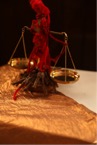
Title: Witch Hunt
Medium: Mixed media sculpture (scales, red wool, wood)
Size: Variable (approximately handheld)
Year: 2025
Description (English): The central motif is the Nüshu character “女” (woman), bound to a cruciform scale. Beneath it lies a pile of stacked twigs, evoking the historical witch burnings. This work critiques the ongoing structural “witch hunts” in contemporary society—when balance becomes judgment, femininity becomes the heretic.
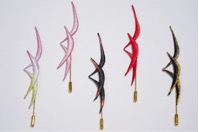
Title: Her Pin
Medium: Handmade thread flowers, embroidery silk, brass pins
Size: Variable (6–10cm per pin)
Year: 2025
Description (English): This series translates the Nüshu character “女” into delicate thread flowers using chuan hua (缠花), an intangible Chinese heritage craft. Worn on the body or in the hair, each pin becomes an intimate yet powerful declaration of gender identity—carrying history in miniature, allowing Nüshu to live again as a soft, mobile rebellion.
Shiman Li is a multidisciplinary artist whose practice explores femininity, cultural memory, and the visual language of Nüshu—the world’s only known writing system created by women. Working across sculpture, craft, and wearable art, she reimagines the female symbol in forms that confront both historical violence and contemporary resilience. Her works, such as Witch Hunt and Her Pin, reflect on how women’s identities are bound, judged, and transformed within structures of power, while also offering gestures of quiet resistance. Through material experimentation and cultural heritage techniques, Li’s practice seeks to make visible overlooked voices and affirm the strength of softness.
14.Yunchao Ke
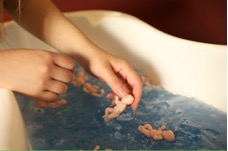
Yunchao Ke (b. 2000 , China) is a visual artist currently pursuing an MAin Sculpture at the Royal College of Art, London. Her practice investigateseveryday social dynamics through installation, video, and performance.Drawing from lived experience, she explores how individuals relate to eachother and to the objects that shape daily life.
Yuxin Zhang
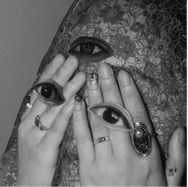
"Veiled in Red" presents a bride whose vision is covered by a traditional wedding veils and a pair of hands. The vibrant red, culturally symbolic of luck and celebration, here takes on an ambiguous quality - at once protective and smothering. The work explores how rites of passage can function as thresholds where personal and collective memories intersect, often at the cost of individual visibility. The covering hands suggest both the guidance and limitations imposed by generational expectations.
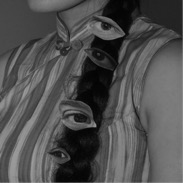
In "Eyes Braided", a young woman in a qipao wears eyes embedded along the length of her hair braid. This juxtaposition of traditional dress with invasive, watchful elements speaks to the dual pressures of cultural preservation and external scrutiny. The braid - typically a symbol of heritage and femininity - becomes both adornment and chain, visually manifesting how collective memory can simultaneously empower and constrain. The displaced eyes represent the persistent gaze that defines, exoticizes, and judges cultural identity from both within and outside the community.
My artistic practice investigates how memory and belonging are negotiated in cross-cultural contexts, particularly through the lens of gendered cultural symbols. The submitted works employ surreal visual metaphors to articulate the tensions between inherited traditions and individual identity in diasporic experiences.
Through these staged photographic interventions, I create symbolic landscapes where cultural artifacts become contested sites of memory. By distorting and recontextualizing traditional garments and gestures, the works visualize the complex negotiations of belonging - where heritage is simultaneously carried, performed, and resisted across geographies and generations.
Yuxin Zhang was born in Jiangxi, China. After graduating from the University Of Glasgow, MSc in Education, she started her own journey of photography practice in Glasgow in 2024. Her body of work focused on the live music scene and experimenting with the practice of digital and analogue photography.
Junaina Muhammed
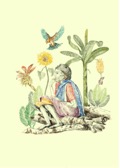
"All these mountains are not just ours"
Junaina Valappil's artistic practice engages with a continuum of pragmatic, aesthetic, and substantive complexities that conjoin the realms of 'art' and 'politics' with the intent of portraying contemporary society. Central to this endeavour is the utilization of artistic and creative expression as instruments for advancing social equity and addressing enquiries related to key themes such as adverse consequences of capitalism, human rights, labour, and class. The exploration encompasses a diverse array of mediums including illustration, photography, printmaking, and painting, each employed to meticulously convey cogently formulated ideas and concepts to the viewer.
Ji Yoon Lee
On an Act of Sensing: Space features Korean language and ambulatory movement. In Korea, when referring to architectural space, we use a traditional unit called pyeong. A pyeong (abbreviated as py) is a Korean unit of area equal to 3.31 square metres or 36 square feet. Although Korea officially uses the metric system, pyeong remains the primary way of communicating floor space. Due to this cultural background, the UK’s imperial system felt particularly unfamiliar and disorienting to me.
In the film, the performer walks along the edges and within the outline of a square foot. Drawing from this embodied experience, the performer uses charcoal to trace their movements on paper. At the end of the film, the drawing is shredded, and the fragments are reconfigured into sculptural forms as part of an installation alongside the video. This gesture reflects upon how spatial concepts can feel alien and transformable across cultural contexts.
The narration counts footsteps in Korean, and as the drawing is destroyed, the voice gradually transforms into a clicking sound. This shift introduces another sensory layer—sound—as an extension of the bodily experience. The work reflects upon my ongoing negotiation with spatial and cultural experience as an artist living between different architectural and linguistic systems.
Mercury Nanashi
Mercury Nanashi / Wang Huixian
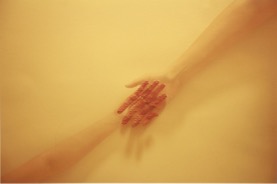
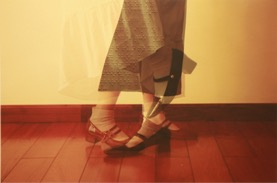
Love Letter
This series of photographic works was created in Edinburgh. It is an artwork exploring the emotional appeal of Echoes Reimagined, aiming to reconstruct and visualize emotional bonds between lovers apart in unfamiliar place. The work stems from observations of the dilemmas in intimate relationships: separated by time and space, emotional bonds become difficult to perceive, leading to gradual estrangement. The artist gained inspiration by traveling to locations both individuals had visited in different times in this foreign city, attempting to reconstruct their emotional connection. This series was born from that process.
The artist use a combination of photography and paper sculpture. Images captured by both individuals at different moments within the same space are superimposed. Using paper sculpture techniques, Braille – a language characterized by its invisibility yet tactile nature – is carved into these areas of overlap. This visualizes the emotional link between two people who existed in the same space at different times, materializing it into a tangible entity. Thus, an encounter transcending time is completed within the imagery.
This work is an experiment in sustaining long-distance emotional connections. It seeks to offer a measure of solace to those who miss each other across distances – conveying that even when physically apart, the bonds between people do not vanish. Instead, they resonate continuously through mutual longing.
Yuchen Li
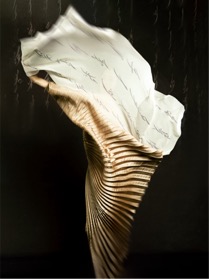
Yuchen Li, who also goes by the name Moxi—a gentle nod to the Japanese greeting moshimoshi, signifying a soft affirmation of presence—is a fashion and art photographer based in London. She holds a degree in Visual Communication Design from Shanghai Jiao Tong University and is currently pursuing Fashion Photography at London College of Fashion, UAL.
Her work has been recognized with multiple photography awards, including ITCD and the Beijing Fashion Week Photography Competition. It has appeared in publications such as Vogue Italy, Pap Magazine, and was exhibited in My Body, Whose Choice.
Moxi’s practice is rooted in a deep sensitivity to the quiet, often unnoticed beauty of everyday life. “I love photography too much,” she once wrote in her diary. “I don’t want to design or market anymore—I just want to photograph for the rest of my life.” Through her lens, she captures the delicate poetry in mundane moments: white flowers, the sweetness of honey, soft cotton, the fleeting light in a girl’s eyes. These subtle fragments, shimmering with emotion, form the language through which she shares her vision of the world—an invitation to pause, notice, and feel.
Yuan Fang
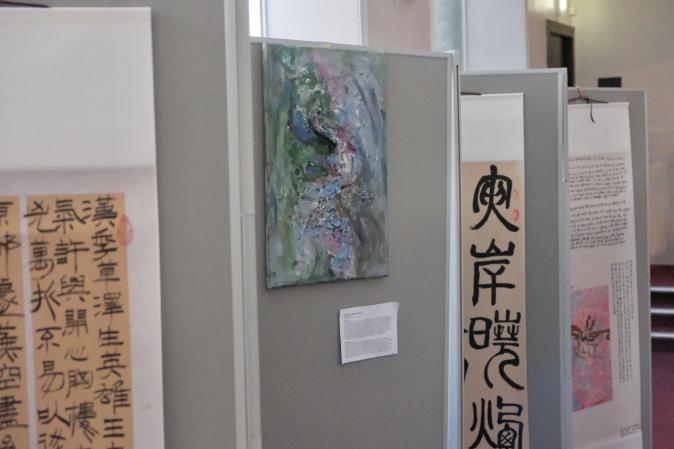
Title: Thread Between Worlds
Medium: Acrylic, Textile, and thread on canvas
Employing painting and textiles, Yuan intricately combines traditional Chinese motifs with abstract forms, creating layered dialogues that explore the fluid boundaries between rootedness and mobility. She weaves migratory trajectories through painterly structures, exploring how “identity” is redefined through movement, choice, and integration. In her work, traditional patterns are not static decoration but an ongoing act of stitching—at once the fissures of regional culture and the sutures that mend them.
Born in China and currently based in London, Yuan Fang is a contemporary artist whose work navigates the intersections of identity and diaspora. Her international trajectory—spanning Seattle, Berkeley, Melbourne, Beijing, and now London—deeply informs her practice, prompting nuanced inquiries into authenticity and adaptation within shifting cultural landscapes. Her background in psychology and extensive social work experience imbue her work with emotional depth and social consciousness. Yuan invites contemplation on the universal tension between assimilation and cultural authenticity, establishing herself as a compelling voice among contemporary artists addressing globalization, identity, and cross-cultural narratives.
Poets lists
Nazaret Ranea
Dream 17
Aileen Angsutorn Lees
Carolina Daiha
Exhibition Experience:
Visitors will encounter works that blur the lines between past and present, familiar and foreign. Sacred symbols and ancestral rituals intertwine with contemporary practice, forming dialogues that are at once intimate and universal. Each piece invites reflection on resilience, continuity, and the invisible threads connecting people across time and geography.
Curatorial Vision:
"Echoes of Time · Kindred in a Foreign Land" is a hymn to memory and continuity, says co-curator Ying Yang. "It celebrates resilience, shared identity, and the power of artistic expression to bridge cultures. As visitors journey through the exhibition, they will encounter whispers of the past, rediscover kindred spirits in a foreign land, and witness echoes that continue to shape our present and future."
Curators:
Jiayi Chen (陈嘉奕): Edinburgh-based artist, producer, and founder of The Great Her collective. First Chinese woman to receive the Creative Edinburgh Award.
Ying Yang (杨颖): Independent curator and member of The Great Her collective, specializing in cross-cultural, socially engaged art practices.
Dates & Venue:
CCW 2025 – Echoes of Time · Kindred in a Foreign Land
Venue: King’s Hall Balcony
Dates: 2nd - 10th August
Free entry / ticketed events as specified